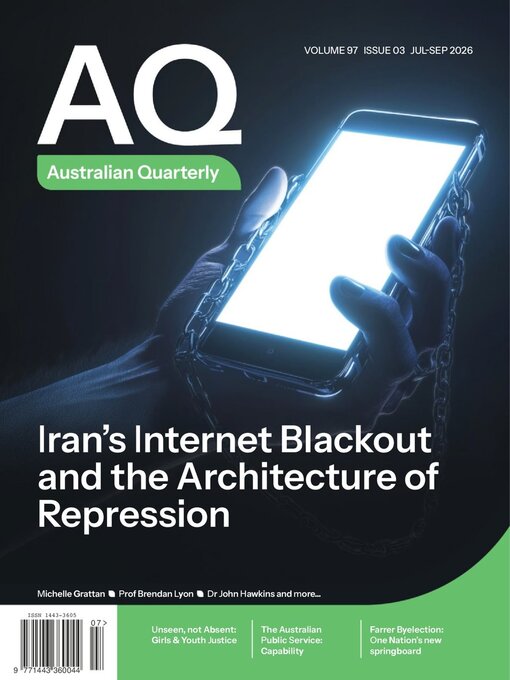
 97.3 July-Sept 2026
 97.2 Apr-June 2026
 97.1 Jan-Mar 2026
 96.4 Oct-Dec 2025
 96.3 Jul-Sept 2025
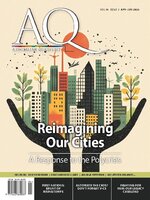 96.2 Apr-Jun 2025
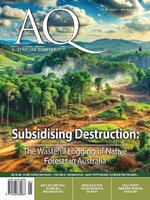 96.1 Jan-Mar 2025
 95.4 Oct-Dec 2024
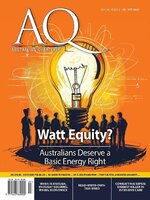 95.3 Jul-Sept 2024
 95.2 Apr-Jun 2024
 95.1 Jan-Mar 2024
 94.4 Oct-Dec 2023
For over 90 years AQ: Australian Quarterly has been packing its pages with the debates that have shaped Australia and the world, tackling the big topics in science, politics and society. Grounded in evidence, yet written in a style accessible to everyone, AQ is unique in Australia’s publishing landscape, pushing back against the trends of subjective truth and media spin. If it matters to Australia then it matters to AQ.
Digital Subscription
Australian Institute of Policy and Science
Digital and Print Subscription
A Word
Notes for Contributors
AQ: Australian Quarterly
Farrer Byelection Gives One Nation New Springboard • The May 9 2026 byelection in the southern New South Wales seat of Farrer was a seminal moment for the right of Australian federal politics. It saw the insurgent One Nation Party, under its leader Pauline Hanson, win a House of Representatives seat under its own name for the first time, in a contest in which the incumbent Liberal Party’s vote collapsed from 43% at the general election just a year before to 12%.
Unseen, not Absent: Girls & Young Women in the Justice System
Dressed Up With Nowhere To Go: Data, AI, and Better Policymaking • Data is increasingly treated as a foundational resource – essential for innovation and transformation across industries and central to modern governance. In policy circles, ‘data-driven’ decision-making has become an ideal, even as its real-world implementation remains uneven. While the availability of data has grown, policymakers and public institutions still often struggle to make meaningful use of it, leaving ‘data-driven’ as more aspiration than practice.
The Australian Public Service: What of the Sovereign’s own Capability? • With the geopolitical and economic certainties of the late twentieth century unravelling, Australia must reconsider what constitutes genuine sovereign capability. We cannot simply rely on fickle multinational industries or the best intentions of elected governments; vast amounts of our national capability resides in the Australian Public Service (APS) as the enduring institutional apparatus through which the state’s choices are formulated, implemented, reported, and revised over time.
Iran’s Internet Blackout and the Architecture of Repression • I belong to an older generation of this struggle. Long before the Islamic Republic perfected the art of nationwide internet blackouts, many of us had already encountered the regime’s digital repression in its earlier forms: surveillance, censorship, intimidation, and the narrowing of civic space. For some, including me, the price was exile.
References
AQ Australian Quarterly