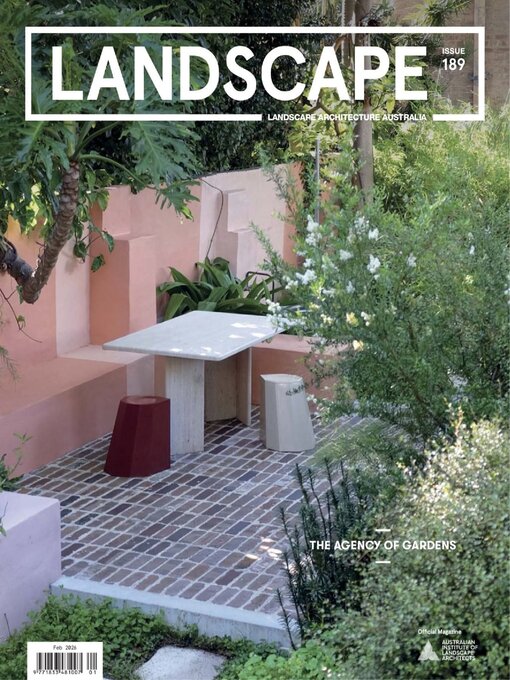
 Issue 189 February 2026
 Issue 188 November 2025
 Issue 187 August 2025
 Issue 186 May 2025
 Issue 185 February 2025
 Issue 184 November 2024
 Issue 183 August 2024
 Issue 182 May 2024
 Issue 181 February 2024
 Issue 180 November 2023
 Issue 179 August 2023
Landscape Architecture Australia is an authoritative and contemporary record of landscape architecture, urban design and land-use planning in Australia, presenting independent reviews of public, commercial and residential work, plus commissioned comment on contemporary issues. The official magazine partner of the Australian Institute of Landscape Architects.
Contributors
Landscape Architecture Australia
THE AGENCY OF GARDENS
Roadside palette: plants for neglect • Keeping roadside vegetation alive can be challenging, and choosing dependable species that can tolerate the toughest conditions is crucial.
LIVING SYSTEMS AND THE LEGACY OF CARE • A message from AILA director Esperanza Kelly
Garden products, plants and systems • From living wall structures and shade systems to hardy groundcovers and drought-tolerant lawn.
Garden state: Housing, planning and ecology • Housing policy in Victoria needs to reconnect homes to the landscapes that sustain them and harness the enormous potential of gardens as shared public infrastructure.
Designing gardeners • When it to comes to making gardens, our role as landscape architects isn’t just about shaping space, but about cultivating meaningful relationships between people and plants.
Mulch and water: Learning from gardening practices • While the level of care we apply to gardens may never be feasible when it comes to tending to large-scale landscapes, there are two techniques we can learn from gardening practices: how to mulch correctly, and the use of irrigation.
Instant, low-maintenance ground cover
Cultivating kitsch: Against the blandscape • In a world of homogeneity and environmental calamity, kitsch introduces friction and discomfort, making us look again and think anew.
Testing grounds: Gardens as laboratories • Jess Stewart speaks to three designers – Timothy Mitchell, Gini Lee and Robert Champion – about how they are embracing their home gardens as sites for exploration and experimentation.
Suburban oasis: Biodiversity in the garden • Private gardens and street verges collectively make up more than 70 percent of Melbourne’s space for biodiversity improvement. Here’s how we can help make designing for wildlife in these sites the norm.
Bulwer Avenue Garden • Banksia and Lime’s design for the garden of a heritage cottage in inner Boorloo/Perth prioritises canopy, memory and community.
Hedge and Arbour House • Emergent Studios’ design for the garden of a dwelling in Melbourne’s north east connects deeply with the site’s bushland context and fosters an ongoing dialogue between its different inhabitants.
Local hero: Robert Champion • Robert Champion, founder of Warrane/Sydney-based practice Tarn discusses aesthetics, experimentation and ecological responsibility in garden design practice.
Patterning the landscape • The NSW Housing Pattern Book Landscape Design Guide aims to provide practical advice for how to create landscape plans for low-and mid-rise pattern book development. But how successful is it – and is it beneficial to streamline design in this way?
Gardening as an agent of change • As a profession, we have long advocated for the value of urban landscapes, but in scaling up to green infrastructure, with monitored maintenance and operational requirements, we have turned our backs on gardens and gardening.
Meeting this place with gardening thinking • Gardening places humans within a relational field with our other-than-human kin, a necessity in these times of ecological and biodiversity decline.
Addressing canopy loss through planning • Research has shown that for trees to provide the best cooling benefits in urban environments, they need to be close to home, and there needs to be lots of them. How can we work to achieve...