 AW 108
 AW 107
 AW 106
 AW XVIII.5
 AW XVIII.4
 AW XVIII.3
 AW XVIII.2
 AW XVIII.1
 AW XVII.6
 AW XVII.5
 AW XVII.4
 AW XVII.3
 AW XVII.2
 AW XVII.1
 AW XVI.6
 AW XVI.5
 AW XVI.4
Ancient Warfare is a unique publication focused exclusively on soldiers, battles, and tactics, all before 600 AD. Starting with ancient Egypt and Persia and continuing to the fall of the Western Roman Empire, Ancient Warfare examines the military history of cultures throughout Europe, the Middle East and parts of Asia and Africa. Ancient Greece and Rome receive the most frequent coverage, due both to the wealth of contemporary sources and the modern fascination with these two great civilizations. Subject-matter ranges from the familiar to the more obscure: while Alexander the Great, the Persian Wars and Caesar’s Gallic campaigns all receive regular coverage, Ancient Warfare also looks at some of the less common parts of ancient military history, from chariots as battle taxis to PTSD in antiquity.
Ancient Warfare Magazine
PRELIMINARIES • THE LATEST NEWS AND DISCOVERIES IN THE FIELD OF ANCIENT MILITARY HISTORY
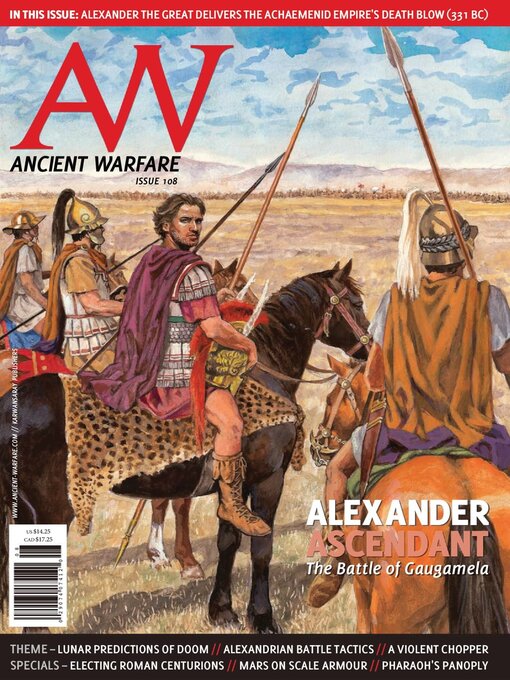
EDITORIAL — Gaugamela reconstructed
From Bronze Age towers to Iron Age ritual centres
TOMB OF PICENTE WARRIOR PRINCE DISCOVERED
DNA proves dynastic rule among Scythian elites
GREEK CAMP SUGGESTS MILITARY PRESENCE IN CENTRAL ASIA
Ancient city's defensive walls studied in Cyprus
Supplies for a Roman legion recovered on lakebed
HAVE YOU READ? • Roman Military Law
In the king's tent
PROTECTING PHARAOH'S BODY IN BATTLE • In pharaonic Egypt, warfare was not only a matter of military practice but also a key medium through which royal power was expressed and legitimized. Over time, weapons and elements of martial equipment were reinterpreted as symbols of divine authority, closely tied to the king's role as protector of order against chaos. While much attention has been devoted to iconic weapons, the role of body armour remains less evident. Did it play a similar double role in Egyptian history?
PICK YOUR OFFICER • Centurions during the Middle Republic were, like the soldiers they commanded, part-time militiamen. As the maniples they led were divided between age-based ordines (ranks) of the triplex acies, centurions were often no more than a few years older than the men they led, and the twenty-somethings in the hastati might well be commanded by a 22-year-old centurion serving on his second or third campaign. Perhaps most surprisingly, centurions during the Middle Republic were elected by the soldiers themselves.
ALEXANDER'S TRIUMPH • Following his victory at the Battle of Issus in November 333 BC (see AW XVI.6), Alexander captured Darius’ camp, including the king's mother, wife, and three children. The imperial treasury had been sent to Damascus, but it was soon captured as well. The defeat was immense and yet, Darius still ruled an empire of almost immeasurable resources and one capable of providing him with a massive army. Darius fled back to Persia and there he raised new troops. He then began to prepare for a final showdown. That would come in 331 BC.
ALEXANDER'S NEW RULES • Alexander's defeat of Darius III at Gaugamela on October 1st, 331, marked the end of the Persian Empire. In the battle, Alexander was massively outnumbered. But it was never a fair fight, because the Macedonians had changed the rules.
AN EMPIRE FALLS • On September 30, 331 BC, the Macedonian king Alexander III crested the Mahad hills adjacent to the modern village of the same name in northern Iraq. The hills had earlier been occupied by Mazaeus and his 3000-strong scouting force. With the approach of the Macedonian army, Mazaeus had left the hills and returned to Darius, his task of ensuring that Alexander found his way to the Great King's chosen battlefield, Gaugamela, complete.
The Agema of the hypaspists
Aftermath
A VIOLENT BLADE • Some weapons fulfill such crucial roles that they become synonymous with conflict...